
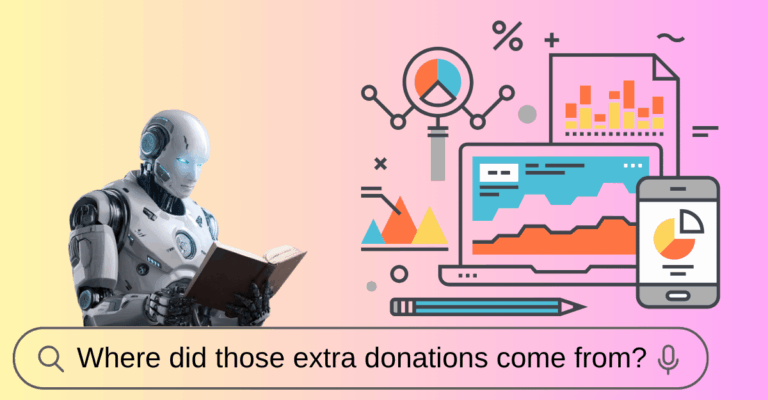
The robots are coming to your analytics data! Google has officially announced the arrival of two new agentic AI tools: Ads Advisor and Analytics Advisor.
Here we’re going to give a bit of a rundown of Analytics Advisor, built into GA4 (Standard and 360) for English-language properties (and probably other languages quite soon after that), rolling out globally in early December 2025.
In short, Analytics Advisor is a conversational AI assistant embedded in GA4 that lets you ask questions in plain English – such as “How is my site doing this month?” or “Why did my active users spike on 25 Sep?” – and it will:
- Pull visualisations and insights directly from your GA4 property for you.
- Conduct “key driver” analysis to help diagnose performance changes (spikes/dips) and attribute causes.
- Suggest next-step actions and recommendations tied to your goals – e.g. “Here’s how you can re-engage the valuable users from that spike”.
- Provide help with configuration/measurement questions too (“What is my Measurement ID?”, “How many data streams do I have?”)
It appears to use the Gemini models (Google’s large language/AI models) behind the scenes.
In other words, it seems to be designed as a sort of “life raft” to help stop you drowning in the usual GA4 data and dashboards by allowing you to have a chat to it and ask it questions about your site performance (or arguably more usefully, the data that you’re seeing in your usual dashboards, for example “why did my site visits spike in mid November?”).
Why this matters for charities
For charities and nonprofit organisations, many of which operate with constrained resources, limited analytics expertise or smaller digital teams, Analytics Advisor brings a number of attractive possibilities:
- Faster, more accessible insights. Rather than needing a dedicated analytics specialist to build reports or dig into GA4 explorations, someone in your team could simply ask the tool a question like “What’s happening with donation conversions in the last 30 days?” and receive a visualisation + commentary. That lowers the barrier to data-driven decisions.
- Democratised data. With conversational AI built in, people who aren’t GA4 experts (fundraising staff, programme leads, marketing coordinators) may access meaningful insights without needing to master all the menus and report types.
- Actionable recommendations. Rather than just “here’s what happened”, you may get “here’s what you should do next” suggestions. For charities that are trying to make every decision count, this is valuable.
- Diagnostics when something shifts. If you notice donation traffic has dropped, or a campaign that used to convert now looks weak, Analytics Advisor can help identify likely drivers of the change (“spike/dip on 25th → likely cause was paid-search traffic reduction in region X”, for example).
- Time savings. Many smaller teams spend a lot of time just hunting through reports. Having a tool that surfaces issues, visualisations and suggested responses quickly frees up time for strategy, creativity and programmes.
Pros & Cons: What to keep in mind
Pros
- Intuitive conversational access to complex analytics. Free-form questions.
- Visualisations + narrative. The AI doesn’t just say “your users dropped” – it shows charts and identifies what was checked.
- Built into GA4 (no separate tool) for eligible English-language properties.
- Guides you from insight to action: “Here’s what to do next”-style suggestions.
- Helps organisations with limited analytics resources to level up their decision-making.
Cons / Caveats
- Language/region limitation: At least initially, only English-language accounts are supported. If your GA4 interface is in another language you may need to switch or wait.
- Accuracy and context: AI models can make mistakes, misinterpret context or offer suggestions based on incomplete data. We’ve heard stories of it giving wildly inaccurate “real-time users” numbers and then correcting itself when prompted.
- Scope limited to property level: The tool uses data from the specific GA4 property; it cannot cross-properties or automatically draw in external data (unless you set it up).
- Cannot replace expertise: While it supports insight-generation, you still need human judgement to verify and interpret context and act accordingly. We think this is particularly true when trying to overlay and understand the many different layers of promotion that your charity may under-take (e.g. GA4 won’t necessarily know if you sent a direct mail pack the week that your site traffic surged, or that your scientific research team had a breakthrough featured on the evening news last night).
- Change management: For teams used to traditional dashboards, moving to conversational prompts might take a bit of change management, training and adjusting workflows.
How charities should prepare to use Analytics Advisor
If you’re a digital fundraiser looking to get more from your Google Analytics data (or even an analogue fundraiser looking to get started) then here are some tips to help you squeeze as much value as possible from Analytics Advisor:
- Check eligibility & update interface language:
Make sure your GA4 property is set to English (if that is required for rollout in your region). Monitor in early December for the “Ask Analytics Advisor” icon or chat panel. - Clarify your KPIs and data structure:
Before relying on AI suggestions, ensure your property is tracking the right KPIs for your charity (e.g. donation conversions, event registrations, volunteer sign-ups) and that data streams/events are set up correctly. - Train your team in prompts:
Encourage your team to ask clear, specific questions (e.g. “Why did donations from organic search drop last month?” rather than “How are we doing?”). The better the question, the more useful the answer. It might be useful to keep an internal log of “quality prompts” to plug into the tool (although Google will likely incorporate more suggested questions as things evolve). - Use it as a diagnostic & idea generator, not a final answer:
Use the AI’s suggestions as a starting point for discussion. Check the insights in GA4, verify the logic, and adapt recommendations to your charity context. - Document learnings and feedback:
If you get strange or surprising answers, log them. Use the thumbs-up/down feedback inside Analytics Advisor to help Google improve the tool (and help you keep track of when you should rely on human judgment). - Link insights to action and impact:
When Analytics Advisor suggests a growth opportunity (e.g. “You could re-engage users who dropped off after the event page”), make sure you have a workflow to turn that into a plan (e.g. email follow-up, landing-page update, targeted ad). Insights are delicious, but without action, the insight isn’t enough. - Embed into your analytics governance and privacy policy:
Understand how your organisation treats queries made to AI, how data is used, who has access and how you’ll review AI-based recommendations (especially important for nonprofits with sensitive data or GDPR obligations).
Special considerations for charities & fundraisers
- Your definition of “conversion” might differ: For a charity the most important event may not be a sale but a donation, volunteer sign-up, petition registration or awareness action. Ensure your conversion/event tracking is properly configured so the Advisor’s suggestions align with what you value.
- Budget and resource constraints: A lot of smaller charities don’t have large analytics teams. Analytics Advisor is a welcome tool for this reason, but you should still build a simple process: review insight → decide action → assign team member → track result.
- Attribution may be complex: Fundraising journeys often span channels (email, offline, social) and take time. Analytics Advisor may identify trends based on GA4 data, but you’ll still need to overlay your organisational knowledge of offline/long-lead channels (think direct mail, face-to-face fundraiser locations, news/pr coverage etc).
- Ethical and transparent use: When using AI tools, especially those touching supporter/donor data, it’s important to be transparent, respectful and compliant with donor privacy policies. If analytics insights lead to outreach, ensure you’re maintaining the trust and expectations of supporters.
- Training and change management: If the team is used to Excel reports or manual dashboards, introducing an AI assistant might need some training: show how to ask questions, how to interpret responses, and when to challenge them.
Putting the anal into Analytics
We’ll go over your analytics config with a fine toothcomb and make sure you’re set up for success. Key events not defined? Tracking code missing? Fear not we’ll get it fixed and working for you.
The arrival of Analytics Advisor in GA4 could prove to be a really positive step for organisations wanting to move from “looking at data” to “acting on insights”. For charities, it offers a powerful opportunity: faster accessibility, more democratic access to analytics, and the potential to make better-informed decisions across fundraising, campaigns and digital programmes. It’s not likely to replace the role of a professional data scientist any time soon but for those charities who simply can’t afford these skills it’s a big step in the data direction!
However, it is not a magic bullet. You’ll still need well-defined KPIs, good event tracking (if your config sucks then so will your insights), human judgement, and a clear process for turning insights into action.
If your organisation uses GA4, this December is a good time to think about how you’ll onboard Analytics Advisor. Get your tracking in order, train your team, and decide how you’ll use the tool to support your fundraising, volunteer recruitment and awareness-raising work.