

Over the past 12 months we ran many paid digital advertising across P2P fundraising campaigns for Australian and international charity clients across a range of causes. Each campaign ran ads on Facebook and Instagram (via Meta) with some also including Google Search. Total ad spend ranged from around $7,000 up to $50K+ per campaign. Registration volumes ranged from around 270 to over thousands of sign-ups.
We’re not going to name the campaigns, this isn’t a case study. Instead, we want to share the patterns that repeated themselves across all four, because those are the things most worth paying attention to.
First, some context on the numbers
The variance across campaigns was significant. The cost of acquiring each registrant ranged from around $11 at the low end to around $190 at the high end.
The share of registrants who actually raised any money sat anywhere between 17% and 51%. Average funds raised per active fundraiser ranged from $141 to $597.
That spread reflects something important: cause type, registration fee, how well-known the campaign already is, campaign length, and how strong the post-registration follow-up programme are all massive drivers in the differences in outcome.
A well-known annual walk campaign with strong organic search presence will always perform differently to a newer challenge-based campaign with a niche audience and a high registration fee.
With that in mind, here’s what we consistently saw regardless of campaign type.
Google kept quietly outperforming Meta on what actually matters
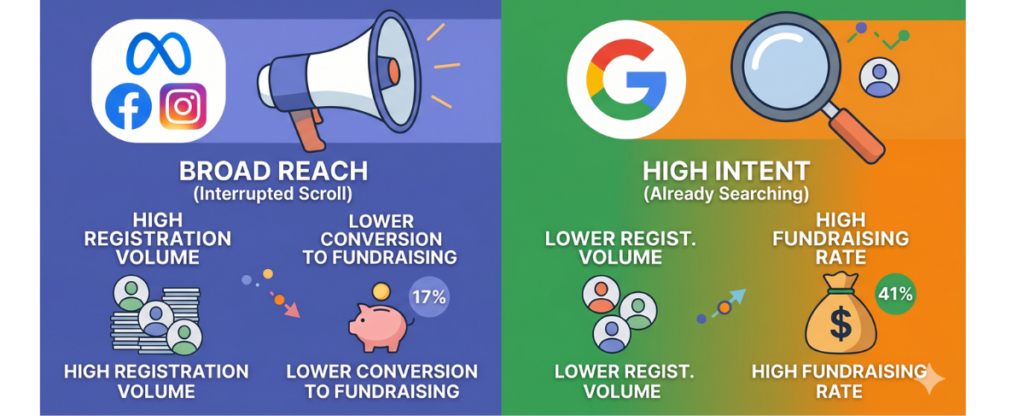
In every single campaign, Facebook and Instagram drove more registrations than Google. That’s expected, social media has a much larger audience pool and can reach people at scale by showing ads to people who haven’t heard of the campaign before. But when we looked beyond raw registration numbers to how many of those people actually fundraised, Google told a different story.
In one campaign, people who came through Google were fundraising at a rate of 41% compared to 17% from Facebook and Instagram, and raising an average of $1,473 each, versus $282, despite Google receiving only around 13% of the total ad spend. In another campaign, Google registrants were 68% more likely to complete their full profile, which is a strong signal of genuine intent.
People who find you through Google Search have already gone looking for you. They’ve typed in the campaign name, a related cause, or a similar challenge. People reached through social media are interrupted mid-scroll. That difference in intent translates directly into fundraising commitment.
The implication is significant. If you’re measuring P2P campaign success purely on the cost of each registration, you’ll consistently undervalue Google. If you measure on the cost per person who actually fundraises, which is ultimately what matters, the picture looks very different. We’d recommend any P2P campaign test putting 20–30% more of its budget toward Google Search and tracking the downstream impact carefully.
Searching for your campaign name converted best. Generic searches rarely did.
On Google, ads shown to people searching directly for the campaign name, or the campaign name plus a city, like “(name of event) sydney”, consistently delivered the lowest cost per registration and the highest sign-up rates. In one campaign, these searches converted at rates between 10% and 40%. That’s exceptional for P2P.
Broader, generic search terms, things like “charity walk”, “cancer fundraiser”, or “domestic violence walk” consumed budget without converting in most cases. We paused these mid-campaign across multiple accounts. The lesson: if someone is typing in your campaign name, they already know about it and are close to signing up. Capture them. If they’re typing a general term, they’re nowhere near that point and the cost to convert them is often too high to justify.
The more interesting finding was the middle ground, what we started calling “cause-aligned” searches. Things like “walk against domestic violence”, “cut your hair for cancer”, “go bald for a cause”. These aren’t searches for the campaign specifically, but they’re not generic either. The person has a specific action in mind. These converted better than generic searches and often more cost-efficiently than broad social media prospecting. They’re worth testing earlier and with more budget than most campaigns currently allocate.
Getting people to register was easier than getting them to actually fundraise
Getting someone to sign up is step one. Getting them to actually fundraise is an entirely different challenge , and it’s one that advertising can only partially solve.
Across the campaigns we ran, between 10% and 28% of paid registrants raised zero dollars. In every case this came up in our analysis, the cause wasn’t the quality of the ads, it was what happened (or didn’t happen) after the registration. Welcome emails that arrived too slowly. Follow-up messages that were too generic. No social nudge or peer encouragement to get that first fundraising amount in.
There’s also attribution issues worth flagging. What the ad platforms reported as registrations consistently overstated what the charity’s own fundraising platform recorded. In one campaign, Meta reported 222 registrations while the fundraising platform recorded 114. This gap makes it very difficult to know your true cost per person who actually fundraises, which is the number you should actually be optimising toward.
A few things moved the needle on activation:
- Discount codes and reduced registration fees. In one campaign, the 7–8% of registrants who used a promo code accounted for over 10% of total funds raised and had a higher average per person than those who paid full price. Lowering the barrier to entry appears to attract more committed participants, not less.
- Emails triggered by fundraising actions. Automated emails sent when someone hit a milestone, first dollar raised, halfway to their goal, $1,000 raised, consistently outperformed emails sent on a fixed schedule. If your post-registration emails are still going out on set days regardless of what the participant has done, it’s worth reviewing that.
- Matched giving announcements. In campaigns where donations were matched by a corporate partner or major donor, the email announcing this outperformed everything else. One campaign’s matched giving email achieved a 47.6% open rate. The lesson: if you have this lever, use it more and earlier in the promotional cycle.
What worked on Facebook and Instagram, and what didn’t
Social media remained the primary acquisition channel in every campaign, so it’s worth going into some detail here.
Letting the algorithm find its own audience kept surprising us
Meta’s “Advantage+” campaign type, where you give Facebook and Instagram’s algorithm maximum freedom to find the right people, rather than specifying detailed audience criteria yourself, delivered the highest registration volume at the lowest cost in multiple campaigns. The algorithm has genuinely improved at this over the past couple of years. We’d recommend making it a core part of any P2P social media strategy rather than treating it as a secondary test.
Interest-based targeting is still worth running alongside it
Building audiences around relevant interests, walking, fitness, charity, health causes, delivered solid secondary volume. The cost per registration was higher than Advantage+, but the quality was reasonable. These are worth keeping as a supporting layer rather than the primary approach.
Retargeting recent website visitors outperformed every other warm audience
Showing ads specifically to people who had recently visited the campaign website, or engaged with the charity’s social media, delivered the most efficient results of any warm audience type. In one campaign, people who had started registering but not finished converted at a cost of under $2 per person. These audiences are small, so they can’t carry a campaign on their own, but they should always be running.
Existing donors largely didn’t convert
This surprised a few of our clients. Targeting existing donors, people who already care about the organisation, sounds like it should work well for P2P. In practice, the cost per registration from these audiences ranged from $395 to $695 across campaigns where we tested them. The most likely reason: being an existing donor doesn’t mean someone wants to run a personal fundraising challenge. The overlap between “someone who has donated before” and “someone who will sign up for a P2P event” is smaller than you’d expect.
Lookalike audiences were inconsistent
Lookalike audiences, where you ask Facebook to find people who are similar to your existing supporters, showed high click-through rates but didn’t consistently translate into lower cost per registration. The quality of the original list was the key variable. Lookalikes built from people who had recently registered or actively fundraised performed meaningfully better than those built from broader donor databases.
Creative: simple won every time
Simple, people-focused static images were the best conversion creative. Not the most engaging. Not the most clicked, but the best at actually generating registrations at an efficient cost. The strongest performing ad in one campaign, a straightforward image of a person with bold cause-messaging text overlaid, drove 137 sign-ups at the lowest cost of any creative tested.
Authentic, participant-led content punched above its weight. Real photos of participants, short selfie-style videos, genuine personal stories, this type of content consistently delivered a strong balance of cost and conversion. People respond to people, not polished brand imagery.
Video drove clicks, not sign-ups. Video ads typically showed strong engagement and reach but converted at a higher cost per registration than static images. The right use for video in P2P is building awareness early in the campaign and retargeting people who’ve already shown interest, not as the main driver of registrations.
Urgency versions of existing ads are underused. Adding a “last chance to register” message to a top-performing static ad consistently revived performance in the final campaign phase. It costs almost nothing to produce and the impact is reliable. Most campaigns only deployed this in the final week, there’s a strong case for introducing it earlier and more aggressively.
How you spend your budget across the campaign matters as much as how much you spend
One of the clearest patterns across all four campaigns was that the timing of spend across the campaign window matters almost as much as the total amount.
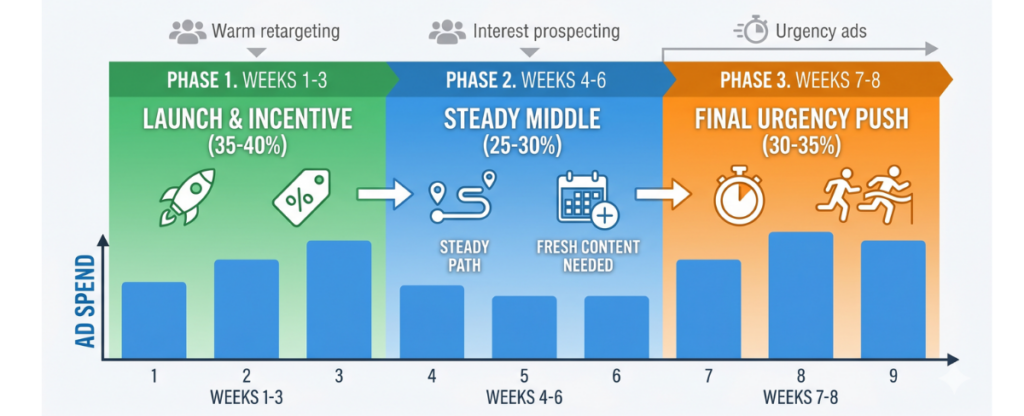
Campaigns with a deliberate three-phase approach, a launch offer or incentive, a steady middle phase, and a push at the end, consistently outperformed those that spread budget evenly across the campaign.
The middle phase, typically weeks two to four, is where P2P campaigns tend to bleed spend. Click-through rates drop, audiences start to see the same ads repeatedly, and without fresh creative or a new reason to register, the cost per sign-up climbs. The campaigns that managed this best pulled back spend in the middle and held budget in reserve for the final push.
Our current recommendation is to put roughly 35–40% of budget into the launch phase (especially if there’s an early bird offer), 25–30% into the steady middle phase, and 30–35% into the final two weeks. The exact split will depend on campaign length, but the principle holds: don’t spend evenly when your audience’s motivation isn’t even.
The attribution problem is real, and it affects every decision
Every campaign we ran had some version of a tracking gap, a difference between what the ad platforms claimed as registrations and what the charity’s own fundraising platform actually recorded. This isn’t a new problem, but it’s worth naming clearly because it materially affects how you read performance and where you choose to put more budget.
Ad platform data will overstate their own impact. The charity’s own platform data will often understate it, because the tracking links that connect an ad click to a completed registration don’t always survive the journey through redirects, privacy settings, and different browser behaviours. The truth is somewhere in between, and you need both data sources to find it.
More practically, if you’re deciding which channel to invest more in based on what the ad platform is telling you alone, you may be optimising toward the wrong outcome. Knowing your true cost per person who actually fundraises, not just per registrant, requires matching up what the ad platform reports with what your fundraising platform records. That matching process needs to be set up before the campaign launches, not figured out at the end.
What we’re doing differently going into the next P2P season
Based on everything above, here’s how we’re now approaching P2P campaigns:
- Put more budget toward Google Search. Not at the expense of social media reach, but enough to properly test whether the quality advantage we’re seeing holds when we spend more there.
- Set up tracking reconciliation between the ad platforms and the fundraising platform before launch. Not after. This is a pre-campaign requirement, not a post-campaign nice-to-have.
- Treat activation as a separate workstream with its own strategy. Paid advertising fills the registration funnel. Welcome emails, social proof, peer nudges, and fundraising incentives are what convert registrants into active fundraisers. These need to be designed in parallel with the media plan, not bolted on after sign-up.
- Start the end-of-campaign urgency push earlier. Two weeks before close, not the final three days. The data supports it.
- Test cause-aligned search terms earlier and with more budget. Searches like “go bald for a cause” or “walk against domestic violence” have shown enough promise to warrant proper investment rather than a small test.
- Build lookalike audiences from people who actually fundraised, not just registered. Lists built from active fundraisers will almost certainly produce better results than lists built from all registrants, many of whom never raised a dollar.
- Consider running ads for longer before the campaign opens. Most P2P campaigns run advertising for four to six weeks. A longer window, eight to ten weeks, gives more time to build awareness, warm up audiences, and allow for the natural consideration period that P2P fundraising requires.
The future for P2P Digi Campaigns
P2P fundraising campaigns ask a lot of paid advertising. You’re not asking someone to donate, you’re asking them to become a fundraiser. That’s a fundamentally different ask, and it requires a fundamentally different approach to how you acquire, activate, and measure participants.
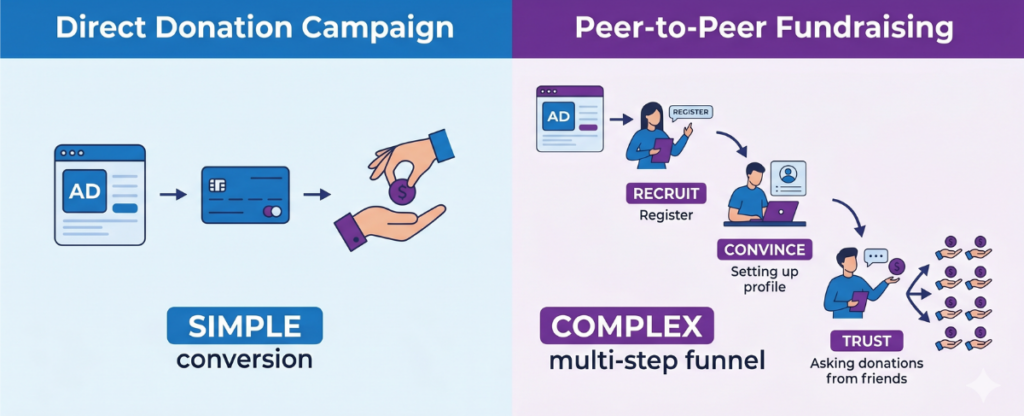
The campaigns that performed best recently were the ones that understood this distinction. They treated paid advertising as the top of a much longer funnel, with strong onboarding, activation incentives, and automated email sequences doing the downstream work. They measured themselves on cost per active fundraiser and total revenue raised, not cost per click or even cost per registration.
Running a P2P campaign this year? Talk to a Ninja today.
Get in touch and we can take a look at your current setup, whether it’s your ad accounts, your fundraising platform tracking, or your activation strategy. We’ve likely seen the challenge you’re facing before.